- Home Stretch
- 4 min
- 09/11/2026

Home stretch | The sun in a twisted doughnut
Timo Bogaarts develops new computational model to optimize nuclear fusion reactors
Nuclear fusion promises clean, virtually inexhaustible energy, but requires technology capable of operating under extreme conditions. Think plasma at 150 million degrees Celsius and ice-cold magnets, arranged in the shape of a twisted doughnut. TU/e researcher Timo Bogaarts has developed an innovative model to help bring the fusion reactor of the future closer to reality.
Recreating the sun on a smaller scale: that is, in a nutshell, what researchers are trying to achieve with the development of nuclear fusion reactors. There are two main types of installations: the tokamak – such as ITER, the world's largest experimental nuclear fusion reactor, currently under construction in southern France – and the relatively new stellarator.
At the Science and Technology of Nuclear Fusion research group, Timo Bogaarts spent the past four years working to optimize stellarator designs. He was the first researcher to develop an accurate, adaptable simulation that allows researchers to optimize nuclear fusion reactors more efficiently.
More on that later. First, let's go back to the sun. There, hydrogen nuclei fuse under extreme pressure and temperature to form helium. This reaction releases enormous amounts of energy. Part of the original mass is converted into energy, according to Einstein's famous formula, E = mc².
Doughnuts and twists
Nuclear fusion thus seems like an ideal energy source: clean, safe, and virtually inexhaustible. But generating that energy on Earth is technically extremely challenging, Bogaarts explains.
“The conditions at the core of the sun are extreme. The pressure, for example, is 250 billion bar, and the temperature reaches no less than 15 million degrees Celsius. By fusing the hydrogen isotopes deuterium and tritium instead of ordinary hydrogen nuclei, the reaction can also take place at low pressure. However, this requires a much higher temperature: around 150 million degrees Celsius.”
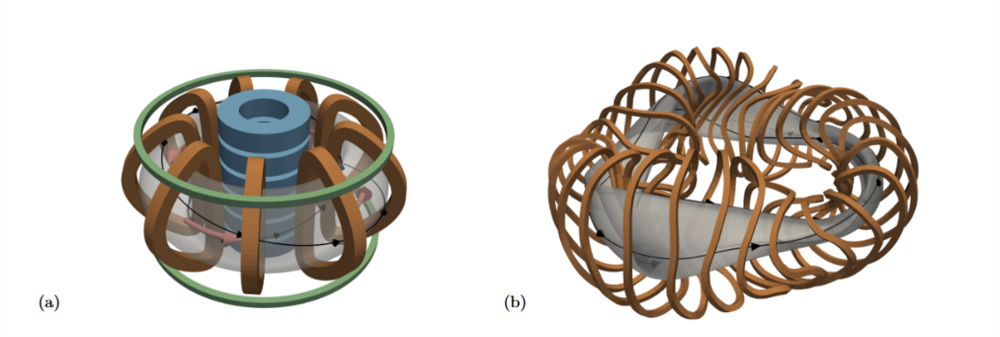
At this temperature, deuterium and tritium turn into plasma: an extremely hot state of matter in which atomic nuclei can move freely and fuse with one another. To confine this plasma and keep it stable, researchers use powerful magnetic fields. In a tokamak, these form a doughnut shape. In a stellarator, the doughnut has a twist. More like a ‘wokkel’, in other words.
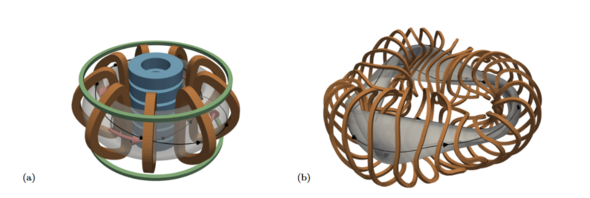
According to Bogaarts, the fact that the electromagnets must be kept at temperatures close to absolute zero to achieve superconductivity poses the greatest technological challenge in a fusion reactor.
“The temperature gradient is enormous. Just a few meters apart, you have two extremes: plasma at 150 million degrees Celsius and magnets cooled to around minus 270 degrees Celsius. Fusion is truly an experimental field of research. We have to build things to test them. The hot plasma and such an enormous temperature gradient are difficult to capture in models.”
Two hundred dimensions
The advent of supercomputers has accelerated the field at breakneck speed. This allowed Bogaarts to devote himself fully to developing computational models over the past few years, he says enthusiastically. His research focused specifically on neutrons, the particles released during the fusion reaction.
Whereas earlier ‘stochastic’ models track large numbers of neutrons and map what happens to these particles, Bogaarts wanted to develop a practical, so-called ‘deterministic’ model. This allows him to predict neutron behavior more quickly and accurately, and incorporate it into the optimization process. This is important because neutrons affect, among other things, the lifespan of reactor components and the production of new fuel.
“When you're working on design optimization, differentiability is very important. You have to try many different things to find out what works best. In one or two dimensions, you can still keep track of everything yourself, but my research involves around two hundred dimensions, and that number is only going to increase. Having a clear search direction is certainly helpful if you want to develop a better reactor more quickly.”
He collaborated with researchers at the German Max Planck Institute for Plasma Physics (IPP) in Greifswald. This is where the Wendelstein 7-X stellarator is located, which Bogaarts describes as one of the most technically complex installations ever built by humanity. Two years into Bogaarts' PhD research, his supervisor left TU/e to join the IPP, allowing Bogaarts to follow the research there more closely as well.
A thinner blanket
After years of pioneering work with a model adapted from the closely related field of nuclear fission, Bogaarts became the first researcher to develop a working differentiable model for the stellarator.
The fact that his model also delivers practical results is evident from an optimization of the protective blanket surrounding the magnetic coils. This blanket acts as a shield against fast-moving neutrons, while also providing structural support and producing fuel. Thanks to his new model, Bogaarts was able to optimize the blanket using a 3D model.
“Instead of the standard 1.5 meters that researchers have traditionally assumed, I show that the multifunctional blanket can be considerably thinner while still performing all its functions.”
Researchers in Germany will now use his model to test a wider range of geometries, helping to accelerate stellarator design.
“In fusion research, the focus of modeling is mainly on the plasma, and much less on the underlying systems. We're trying to close that gap so that we can eventually connect different models. Behind those impressive doughnuts and ‘wokkels’, which we can now display beautifully in 3D, lies a complex interplay of physics and engineering. We first need to understand that properly before we can recreate the sun on Earth.”
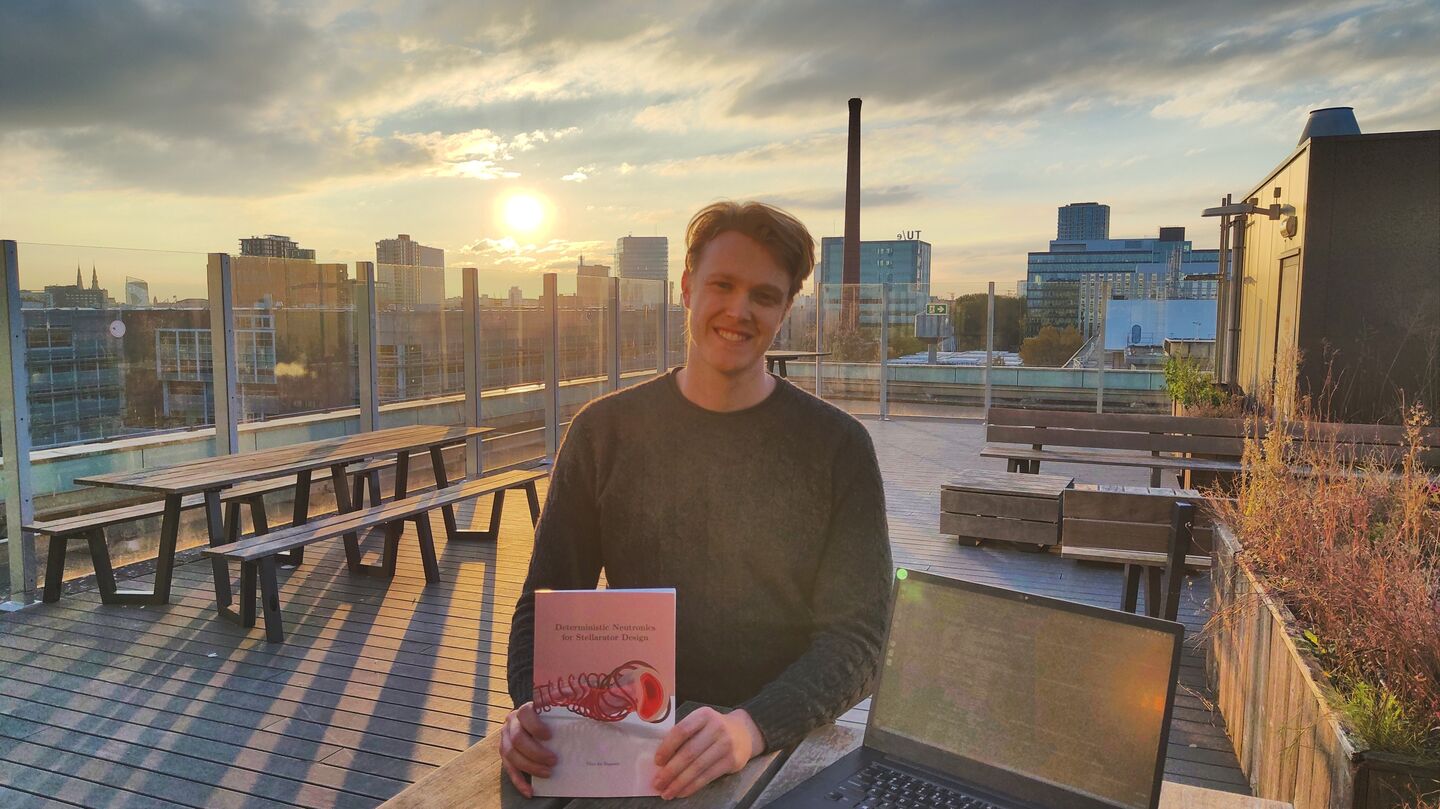
Timo Bogaarts will defend his PhD thesis on Monday, November 9, at the Department of Applied Physics and Science Education.
PhD in the picture
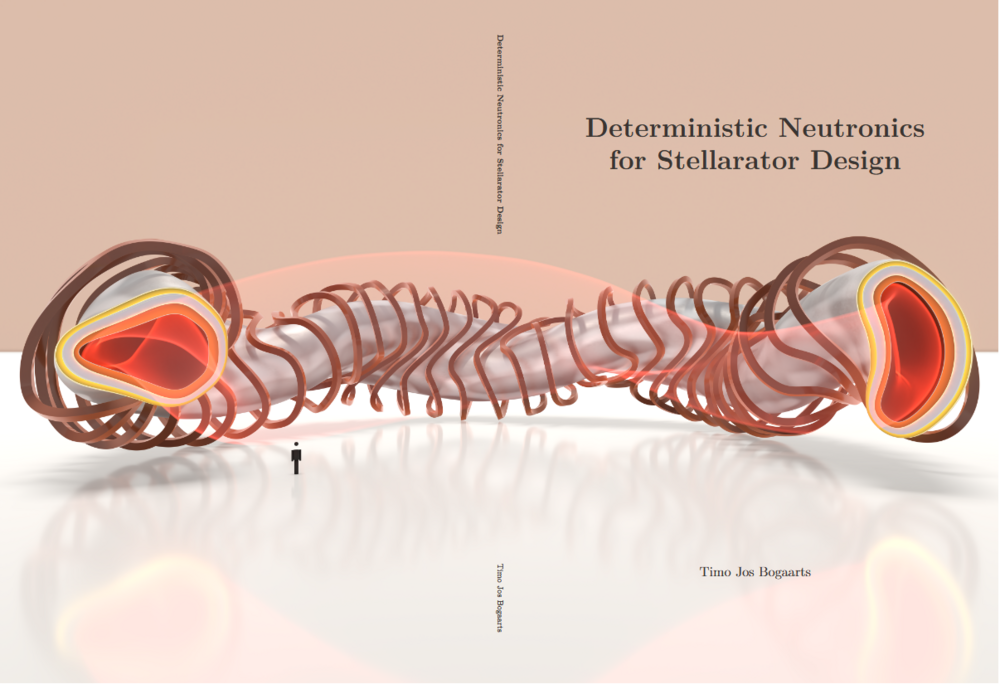
What do we see on the cover of your dissertation?
“A representation of an optimized fusion reactor as visualized by my model. It shows the plasma, the twisted doughnut and, if you look closely, different numbers of neutrons along the edge.”
You're at a birthday party. How do you explain your research in one sentence?
“I develop fast computational models for the design of nuclear fusion reactors.”
How do you unwind outside your research?
“I play a lot of piano, and sometimes I get to fill in as the organist at my grandfather's church. He's the regular organist there. I've also taken up a new hobby over the past six months: brewing beer. I've come up with names like ‘Tonkamak,’ ‘Banana Orbit’ and ‘Tritium Tripel.’ A bit of nerdy beer, you could say.”
What advice would you have liked to receive when you started your PhD?
“Follow your own interests and don't force yourself in a particular direction. I've always had a lot of freedom in my research, although that may also have something to do with the fact that my supervisor moved to Germany after two years.”
What’s your next chapter?
“I'd prefer to stay in fusion research. It's a really hot topic right now. The most exciting developments often take place at startups, and that's where I'm currently exploring opportunities.”
Discussion